The Night Watch: a flagship case study
On this page
Watch the finished public release
The published YouTube version is the definitive public cut, confirmed by the filmmaker. The public Higgs project independently records a 3:36 contest submission, its seven-scene production plan, its generated visual stack, and a continuous cello stem added in post. The filmmaker also confirms that the music was prompt-generated for this project. This case study does not identify a music provider or assert a separate commercial licence.
Watch the 84-second project proof reel. It is a short companion assembled from the later local project render and retains its embedded programme sound. It is not presented as a replacement for the definitive YouTube cut.
Download the educational sample treatment. It is based on the verified story plan and carries the same provenance boundary.
Logline
On the night before a seaside amusement park is demolished, an older watchman walks its rides in his daughter’s order, turning out every light until one final bulb forces a choice.
What the team set out to control
The production plan defined a fixed watchman, a closed coastal park, a restrained camera rule, a key as the opening signature, and a sound plan that separated native effects from the intended score. The aim was not to make every shot elaborate; it was to preserve the same emotional route from key, to rides, to darkness.
The practical challenge
A multi-scene AI film can fail at the joins even when individual shots look strong. The working records focus on three concrete risks: the key’s state across the cold open, the transition from a lit Ferris wheel to its shutdown, and reference-image flashes at selected scene boundaries.
Choices and evidence
| Control | Recorded approach | Evidence boundary |
|---|---|---|
| Story | One worker, one last night, one irreversible sequence of lights going out | Working pack and public film link |
| Continuity | Reused character, location and signature-prop references; a camera follows or waits except for the Ferris moment | Working pack describes this intent; it does not prove every generated frame complied |
| Sound | Native actions were planned separately from a continuous score in post | The filmmaker confirms prompt-generated project music; this case study does not identify the provider or a separate licence |
| Revision | Development notes identify reference flashes, a key-height mismatch, and missing Ferris switch-off action as items to diagnose | Local review candidates are not asserted to be the released master |
From failed candidate to diagnosis
The development review notes record stray reference-frame flashes before selected shots and a missing visible switch-off action before the Ferris lights die. The response was specific: trim or repair the affected boundary, preserve adjacent audio timing where possible, and stage a dedicated breaker insert rather than pretending a trim could create missing action. This is the lesson carried into the Studio workflow: record the observed defect, narrow the repair, then recheck affected neighbours.
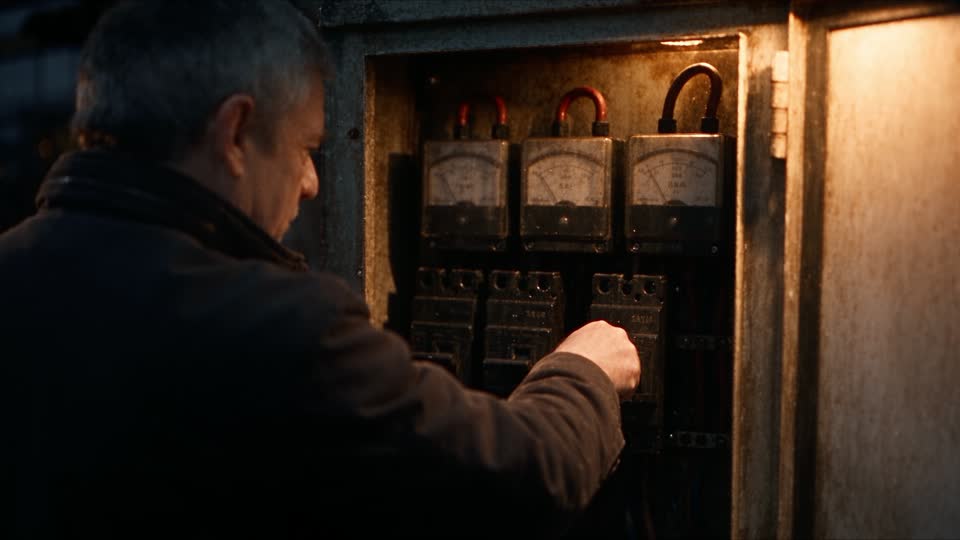
Rejected five-second candidate. The retained review record says its hand action repeated and it did not include the planned door closure, look toward the wheel or departure.
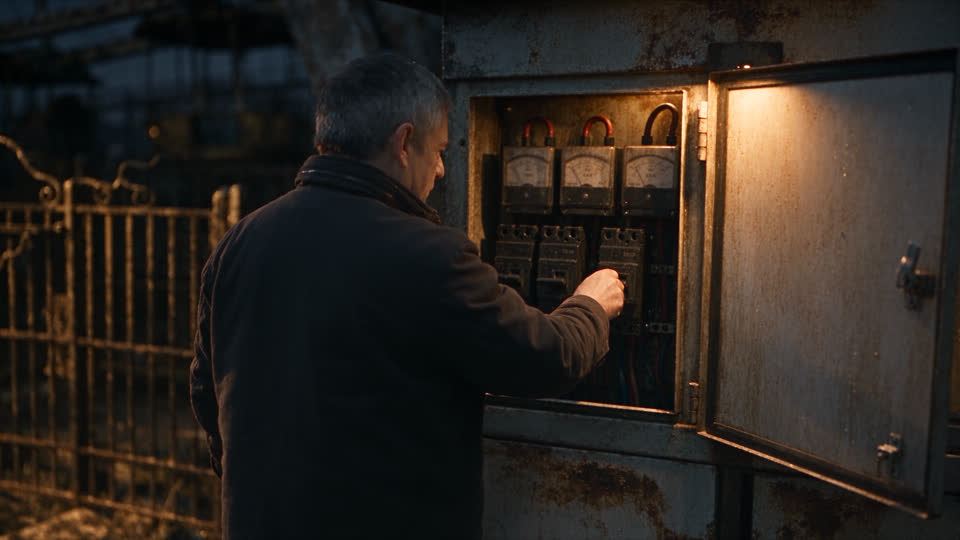
Diagnosis reference. The cabinet, watchman and breaker layout were preserved as the reference for the separate insert.
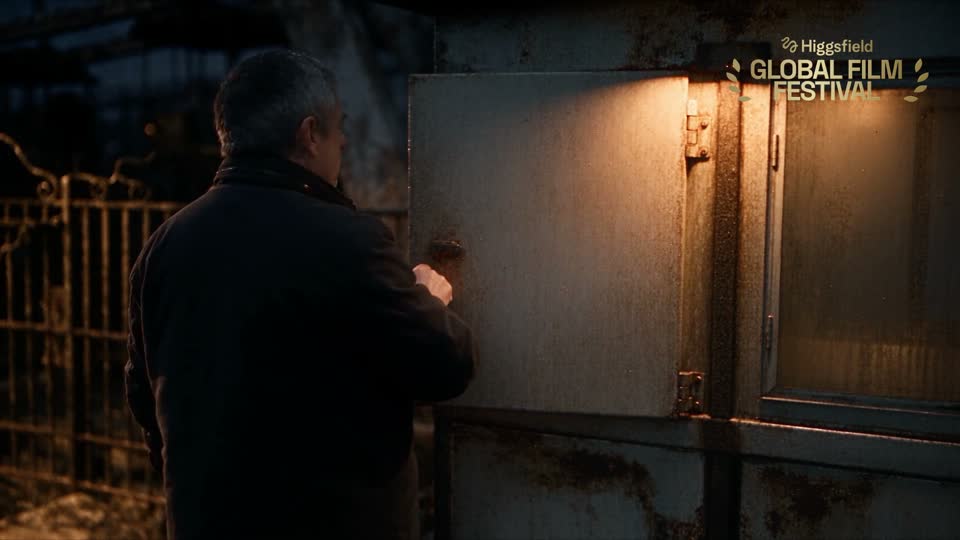
Later local sequence. This later render keeps the cabinet-to-wheel action in context. It is evidence of the later project iteration, not a claim of a byte-identical match to the published cut.
Outcome and limits
The film is available through the public viewing links above. This case study documents the planning and review method, not a forensic certification of a byte-identical local master. The embedded proof reel uses the later local project render as a companion study. It does not claim specific lens metadata, a named music provider, a separate commercial licence, verified credits, awards or independent review.
Reusable lesson
A good-looking candidate becomes usable only after the incoming state, outgoing state, sound, and neighbouring edit are checked together. Preserve failures and decisions as production evidence; do not turn an unfinished repair note into a public claim about the final film.